When I first started studying ultra-luxury aviation, I thought private jets were simply about speed and status. But once you analyze aircraft acquisition costs, operating expenses, global range capability, and customization levels, you realize something much bigger:
These aircraft are not transportation.
They are strategic mobility assets.
In this breakdown, I’m ranking seven of the most expensive private aircraft in the world — from a $21 million business jet to a $500 million flying palace — using verified manufacturer specifications and real-world aviation performance metrics.
If you’re interested in private jet ownership, ultra-long-range business jets, aircraft financing, or VIP airliner conversions, this guide will give you real insight — not marketing fluff.
What Is the Most Expensive Private Jet in the World?
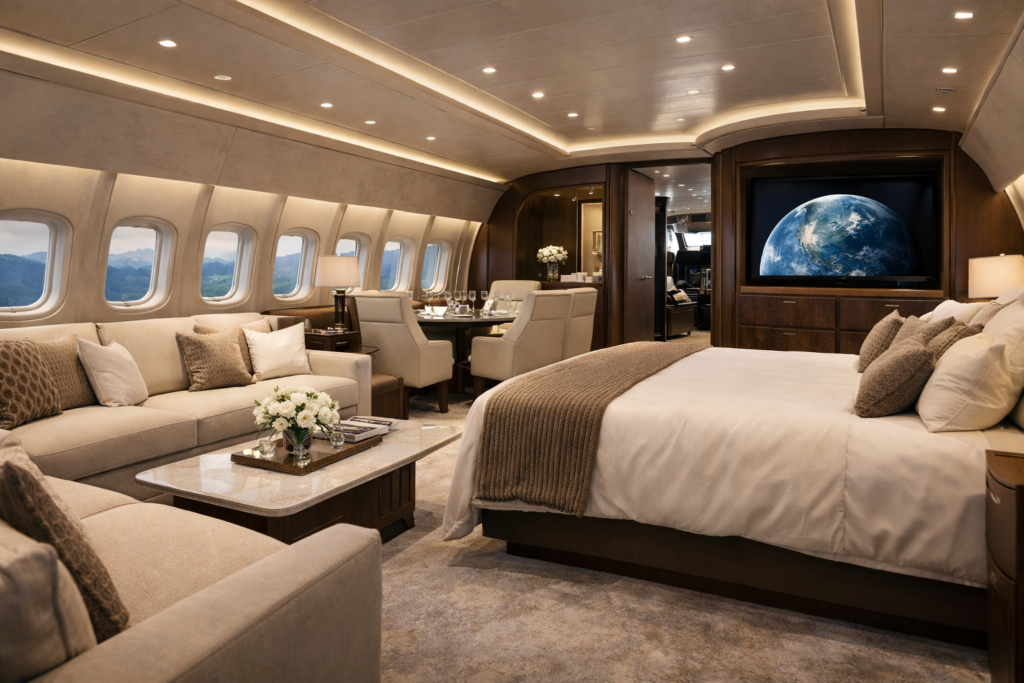
The most expensive private jet in the world is a fully customized VIP version of the Boeing 747-8, valued at approximately $500 million depending on interior customization and mission requirements.
These aircraft feature:
- ~4,500 square feet of cabin space
- Master bedroom suites
- Formal dining rooms
- Private offices
- Dedicated security zones
- Multi-level layouts
- Annual operating costs exceeding $15 million
This category is typically reserved for heads of state and global business leaders.
7. Embraer Praetor 600 – $21 Million Smart Performance
Category: Super Midsize
Range: 4,018 nautical miles
Top Speed: Mach 0.83
The Praetor 600 is often underestimated. At just over $20 million, it delivers transatlantic capability — something many competitors in the $30–40 million range struggle to match.
It connects:
- New York to London
- Los Angeles to Cabo
What makes it impressive from an aviation investment standpoint:
- Full fly-by-wire controls
- Cabin altitude of 5,800 ft at 45,000 ft cruise
- Strong resale market stability
For executives exploring private jet charter alternatives or fractional ownership programs, this aircraft often becomes a smart entry point into global aviation.
6. Gulfstream Aerospace G280 – Executive Efficiency at $24 Million
Range: 3,600 nautical miles
Top Speed: Mach 0.85
The G280 quietly dominates the super midsize segment.
Powered by Honeywell HTF7000 engines, it delivers coast-to-coast U.S. range with strong fuel efficiency — something that matters when jet fuel volatility impacts operating costs.
Key strengths:
- Quiet cabin environment
- Plasma ionization clean air system
- Advanced Symmetry Flight Deck
- High dispatch reliability
From a business aviation management perspective, this aircraft balances acquisition cost, operating efficiency, and brand prestige extremely well.
5. Bombardier Aviation Global 5500 – $46 Million Intercontinental Authority
Range: 5,900 nautical miles
Top Speed: Mach 0.90
This is where true global mobility begins.
The Global 5500 connects:
- Singapore to Los Angeles
- London to Buenos Aires
Its 94-foot cabin includes:
- Dedicated conference space
- Private stateroom
- Nuage zero-gravity seating
For corporate leaders managing international operations, this jet functions as a flying headquarters.
With Ka-band connectivity, executives can run board meetings mid-flight — a critical factor in high-level global asset management.
4. Gulfstream Aerospace G800 – The Longest-Range Business Jet Ever Built
Range: 8,000 nautical miles
Top Speed: Mach 0.925
Price: ~$85 Million
The G800 currently holds the title for longest-range purpose-built business jet.
It connects:
- New York to Hong Kong
- London to Perth
Non-stop.
Its 107-foot cabin supports five living zones, including a master suite with shower.
For ultra-high-net-worth individuals seeking total route independence, this aircraft reduces geopolitical and routing constraints dramatically.
3. Boeing 787 Dreamliner VIP – $200 Million Airborne Estate
When converted into a VIP configuration, the Boeing 787 becomes something extraordinary.
Cabin Space: ~2,400 square feet
Range: ~8,000 nautical miles
Typical custom features include:
- Multiple lounges
- Executive boardrooms
- Full marble bathrooms
- Private offices
- Dedicated crew quarters
Because of its composite fuselage design, cabin pressure remains lower than older aluminum aircraft — reducing fatigue on ultra-long-haul routes.
This is where private aviation transitions into sovereign mobility infrastructure.
2. Airbus A380 VIP – $350 Million Flying Mansion
Cabin Space: ~5,500 square feet
Range: 8,200 nautical miles
The largest passenger aircraft ever built, converted for private ownership.
Reported customizations in past VIP builds have included:
- Spiral staircases
- Turkish baths
- Concert halls
- Full spa installations
- Private vehicle storage
This aircraft is less about efficiency and more about absolute space dominance in the sky.
1. Boeing 747-8 VIP – $500 Million Ultimate Power Statement
This aircraft represents the peak of aviation customization.
Powered by four GEnx engines, it cruises at Mach 0.85 and connects major global cities non-stop.
Inside, configurations may include:
- King-size master suite
- Private dining room for 20 guests
- Multiple lounges
- Security command zones
- Rare wood paneling and bespoke interior finishes
From an operational standpoint:
- Annual operating costs: $15M+
- Dedicated crew required
- Global maintenance network coordination
For global leaders and business magnates, this is not luxury — it is controlled sovereignty.
How Much Does It Cost to Own a Private Jet Annually?
Beyond purchase price, ownership includes:
- Crew salaries
- Hangar fees
- Aviation insurance
- Maintenance reserves
- Engine overhaul programs
- Fuel (often $3–6M annually for large jets)
For wide-body VIP aircraft, total annual costs can exceed $15–25 million.
This is why many individuals explore:
- Fractional ownership
- Aircraft leasing programs
- Private jet charter services
- Aircraft management companies
Ownership is a liquidity decision, not just a luxury decision.
Which Private Jet Has the Longest Range?
Currently, the Gulfstream Aerospace G800 leads the purpose-built business jet category with an 8,000 nautical mile range.
For converted airliners, both the Boeing 787 Dreamliner VIP and Airbus A380 VIP exceed similar global connectivity thresholds depending on configuration.
Final Perspective: Luxury vs Strategy
After analyzing all seven aircraft, one thing becomes clear:
There are two types of buyers in this space.
- Those who want luxury.
- Those who require global strategic mobility.
The Praetor 600 represents smart capital allocation.
The G800 represents long-range dominance.
The 747-8 VIP represents geopolitical presence.
If money were no object, I’d personally choose the G800 for operational efficiency — but if symbolism mattered, the 747-8 stands unmatched.
In ultra-luxury aviation, capability is power.
And at 45,000 feet, power looks very different.